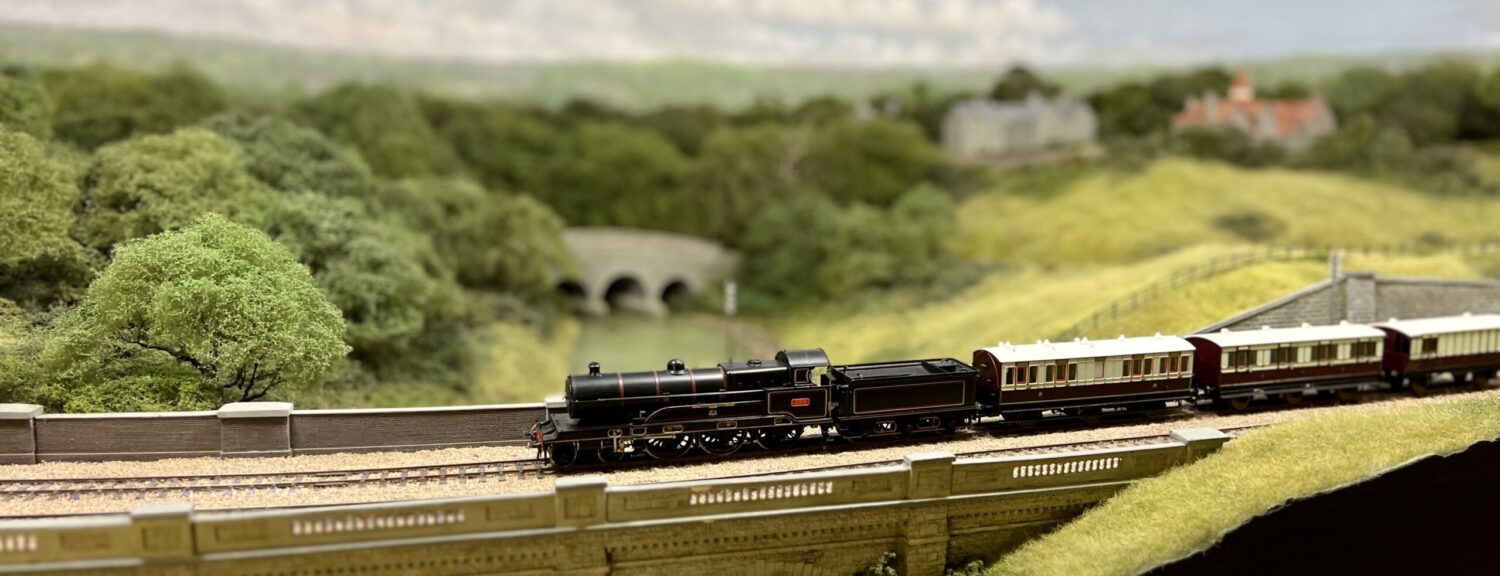
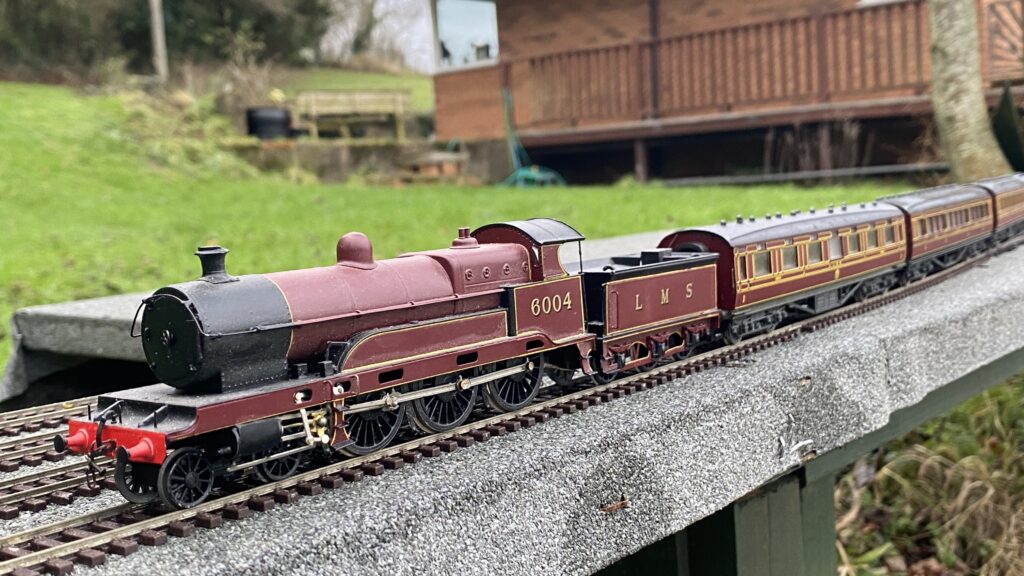
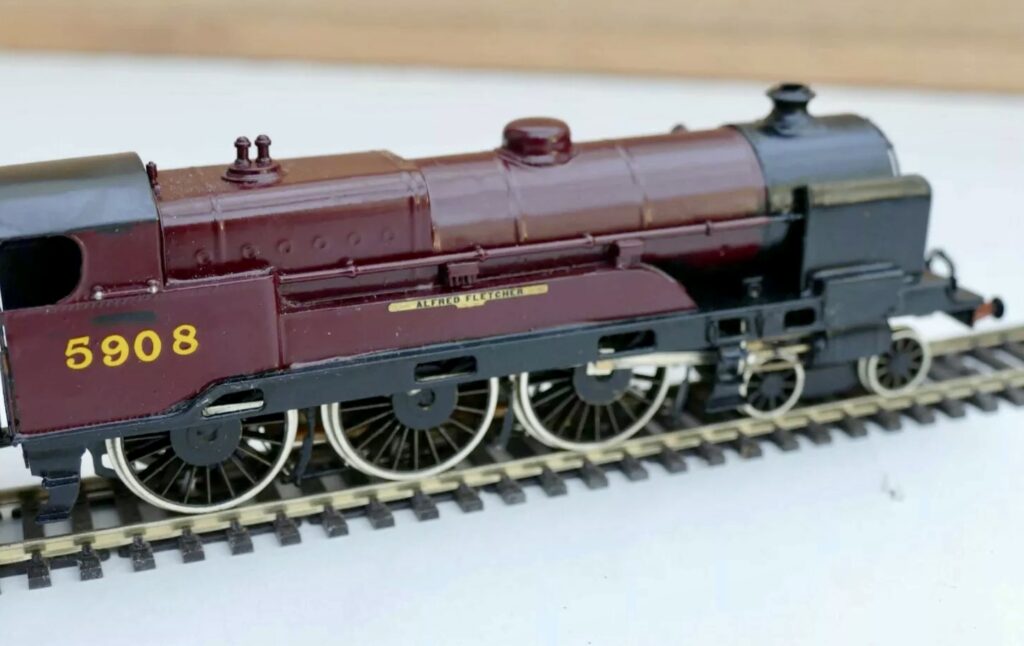
The locomotives were introduced in 1913, the first of the class No. 2222 was named in honour of Sir Gilbert Claughton, who was the Chairman of the LNWR at that time. A total of 130 were built, all at Crewe Works up to 1921. Author Brian Reed points out that weight restrictions and equipment limitations at Crewe limited the size of the boiler, hence engine power. Cylinder design and valve events were not optimal, so the Claughton Class was a mediocre performer on the track.[1]
186 “Breadalbane” on Artist’s Valley
The LNWR reused numbers and names from withdrawn locomotives, with the result that the numbering was completely haphazard. An exception was made for the LNWR’s war memorial locomotives. There were two of these: No. 2097 (built in 1917) was briefly named Patriot for a short period in January 1920; and the name was later given to a new locomotive numbered 1914, which entered service in May 1920 (ordinarily, this locomotive would have been numbered 69, which had been unused since January 1920; but instead, Renown Class locomotive No. 1914 was renumbered 1257 in order to release its old number[2]). The nameplates of both locomotives also bore the inscription “In Memory of the Fallen L & N W R Employees 1914–1919”.[3] Remembrance Day ceremonies at Rugby featured no. 1914 until its name was transferred to LMS Patriot Class No. 5500. The LMS renumbered them into the more logical series 5900–6029, No. 1914 becoming 5964.[4] Twenty were rebuilt by the LMS with larger boilers, and ten of these had Caprotti valve gear. Twelve others were rebuilt as the initial engines of the Patriot Class, though not much material was reused.
With the introduction of the LMS Royal Scot Class in 1927, the Claughtons’ main work had been taken away and many were transferred to the Midland Division. At the end of 1937, all but four, Nos. 5946, 6004, 6017 and 6023, had been withdrawn. These were retained in service until further repair became unworthwhile; three of them were withdrawn in 1940–41, leaving No. 6004, which was regularly used to haul fitted freight trains between London and Edge Hill, becoming increasingly dirty.[5] Inherited by British Railways in 1948, it was allocated the BR number 46004 but was withdrawn in 1949 without it being applied. None were preserved.