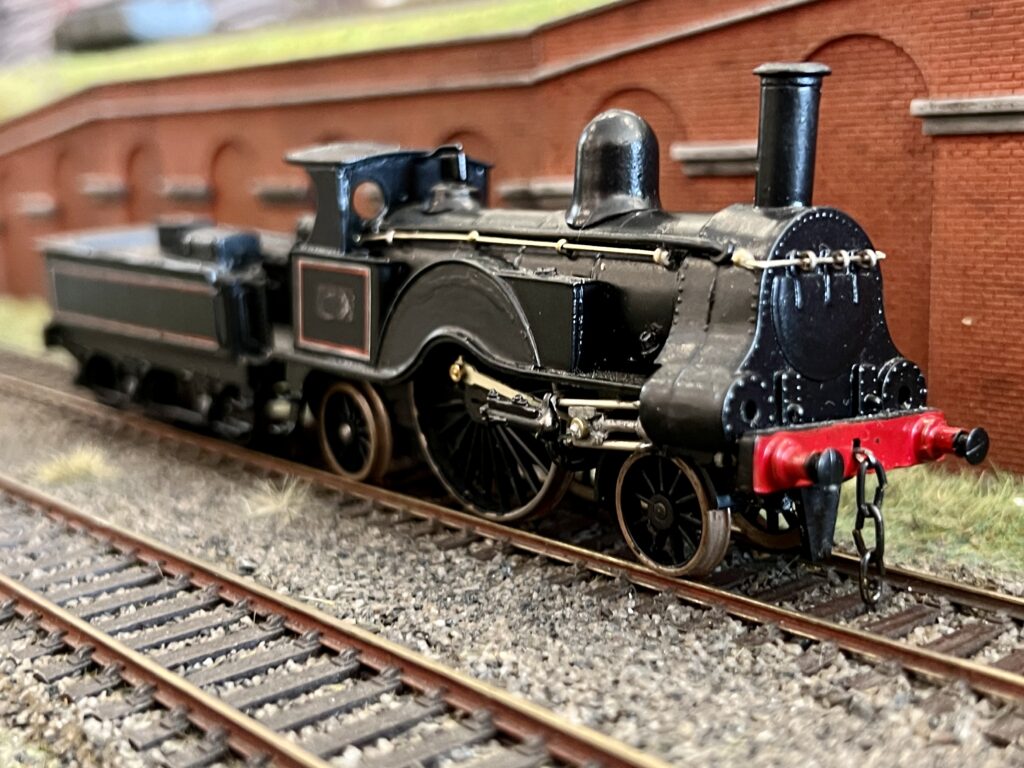
LNWR ‘Lady of the Lake’ or ‘Problem’ Class 2-2-2
The Lady of the Lake class was the second type of locomotive designed by Ramsbottom. It was typical of express passenger locomotives of its era in having a single driving axle with large (7 ft 6 in (2.286 m) in this instance) driving wheels to achieve high speeds
Iin the 1862 International Exhibition, The LNWR exhibited a locomotive and tender fitted with the “Apparatus for supplying water to tenders whilst in motion”. The catalogue made note that this was the same class that ran the “American express” on 7 January,[3] but the locomotive selected was No. 531 Lady of the Lake, rather than Wattitself. The Lady of the Lake was awarded a bronze medal, and the entire class became known to many as the “Lady of the Lake” class.[1]
Operations
The Lady of the Lake class locomotives spent their initial years working the Irish Mail traffic, as well as running local express services in the Manchester, Crewe and Liverpool area. They gained a reputation as “flyers”[1] on the Irish Mail, even though the speed required by the Post Office contract (a 42 mph (68 km/h) average) was not particularly fast by contemporary standards. Sir Richard Moon, Chairman of the LNWR, believed that a speed of 40 mph was sufficient for an express train. The “Ladies” could keep this pace with ease, and were economical to run as well. In later years, however, as speeds and loads increased, the locomotives were used as pilots on double-headed trains, and even some branch services.
Webb’s Rebuilds

No. 531 Lady of the Lake in black livery
In 1873, two years after Francis Webb took over as engineer from Ramsbottom, the new general manager William Cawkwell decided that black should be the standard colour for all locomotives.[9] The Lady of the Lake class were thus painted as Webb added a cab roof and modified the chimneys of the entire class. When the class received replacement boilers from 1879 to 1883 they were also fitted with steam brakes (previously only the tender had brakes, and they were wooden ones) and enclosed splashers.[4]
The “Ladies” received a very extensive rebuild from 1895–1897. This time they were fitted with enlarged boilers and larger fireboxes, round smokebox doors, crosshead vacuum pumps, new 3 in (76 mm) tyres (which increased the diameter of the driving wheels to 7 ft 9 in or 2.36 m), and cross-stays to stiffen the frames.[9] These rebuilt Ladies gained a new lease of life and were often used to pilot express trains, achieving speeds of over 80 mph (130 km/h).[10]